

Retirement Planning in Canada: Why You Should Start Now
When you live in Canada, there may come a time when you start asking yourself an important question: “Will I be able to receive a pension when I retire in Canada?” For Korean immig
When you live in Canada, there may come a time when you start asking yourself an important question:
“Will I be able to receive a pension when I retire in Canada?”
For Korean immigrants, this question can feel especially confusing. There is the Korean National Pension, Canadian public pensions, OAS, GIS, CPP, and other terms that may sound similar but work very differently.
The most important thing to understand is this:
Retirement planning in Canada is not something you start right before retirement.
Even if retirement still feels far away, your years of residence in Canada, work history, tax filing records, and saving habits can all affect your financial stability later in life. That is why it is helpful to understand the basic structure of Canada’s retirement system early and start preparing step by step.
Canada’s Public Pension System: Three Key Programs
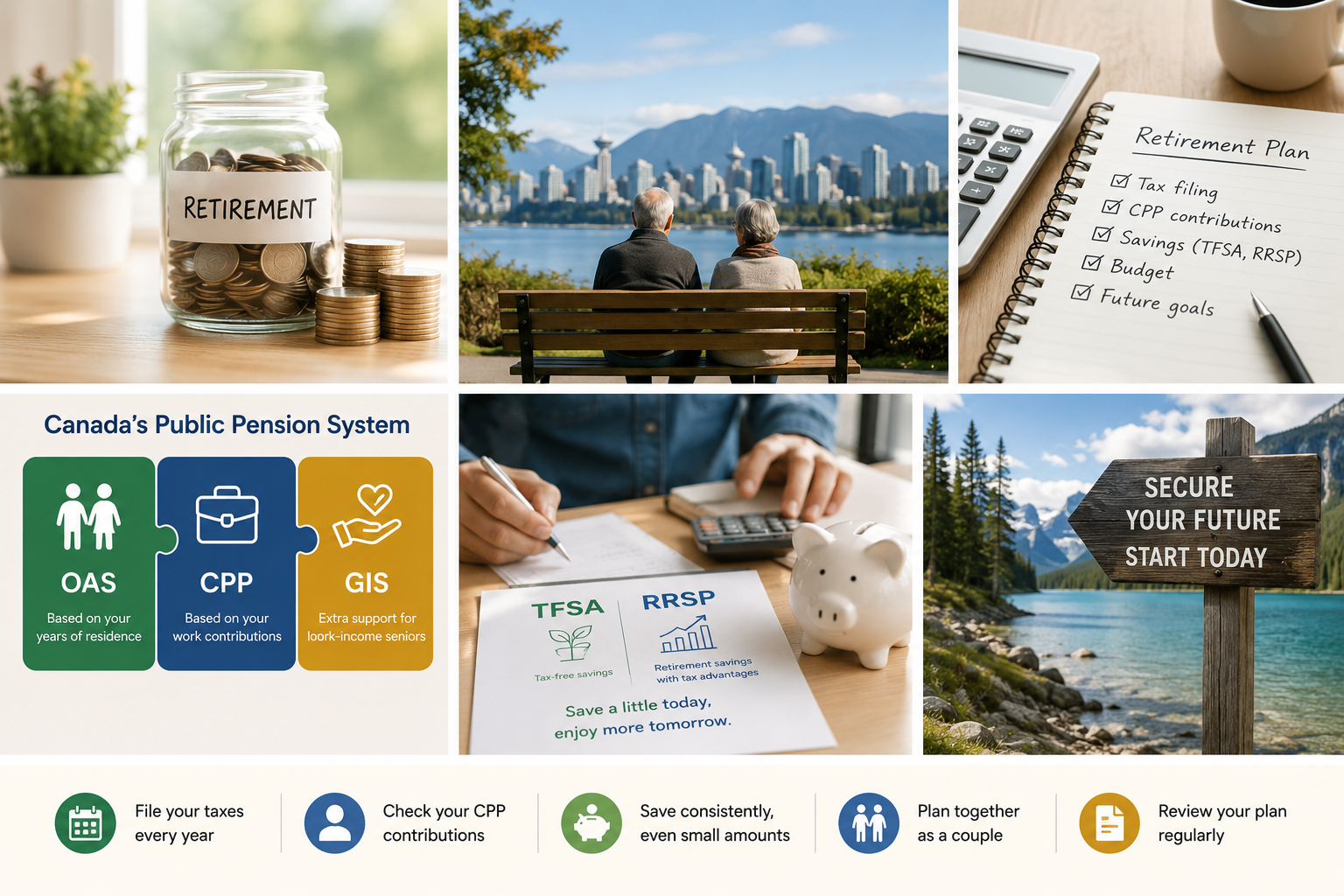
Canada’s retirement income system can be understood through three major programs.
The first is OAS, which stands for Old Age Security.
The second is GIS, or the Guaranteed Income Supplement.
The third is CPP, which stands for the Canada Pension Plan.
These names may sound complicated at first, but the basic idea is actually quite simple.
OAS is closely related to how long you have lived in Canada. CPP is connected to how much you contributed while working in Canada. GIS is additional support for low-income seniors.
Once you understand these three differences, Canada’s retirement system becomes much easier to follow.
OAS Depends More on Residence Than Work History
OAS is one of Canada’s main public pension programs for seniors.
Many people think of pensions as something based mainly on how long they worked. That is true for some types of pensions, but OAS is different from CPP. OAS is more closely tied to your residence history in Canada.
In other words, even if you did not work in Canada for many years, you may still be eligible for OAS if you meet the residence requirements.
On the other hand, if you immigrated to Canada later in life, the amount you may receive or whether you qualify can depend on your situation. This is why OAS is especially important for immigrants to understand.
Some people may think, “I’m still young. Why should I worry about senior benefits already?”
But because OAS is connected to your years of residence in Canada, it is better to understand it early. Waiting until you are close to 65 may leave you with fewer options and less time to prepare.
CPP Is Built Through Your Work Contributions
CPP stands for Canada Pension Plan.
Unlike OAS, CPP is based on contributions you make while working in Canada. If you are an employee, CPP contributions are usually deducted automatically from your paycheque. If you are self-employed, you need to understand how CPP contributions are calculated when you file your taxes.
This is why it is important to check your pay stub. You may see deductions for income tax, EI, and CPP. Many people simply think of these as money being taken away from their paycheque, but CPP is different. It is connected to your future retirement income.
If you are working in Canada, it is worth checking:
- Whether CPP is being deducted properly
- How much you are contributing each year
- How your self-employment income affects your CPP contributions
- What your long-term contribution record may look like
CPP does not build up overnight. It grows gradually over your working years, which is why it is important to understand it as early as possible.
GIS Provides Extra Support for Low-Income Seniors
GIS, or the Guaranteed Income Supplement, is additional support for low-income seniors who receive OAS.
Simply put, GIS is designed to help seniors who have limited income in retirement. However, GIS is closely connected to your income level. Your other sources of income, your spouse’s income, and your annual tax filing records can all matter.
This brings us to one of the most important habits in Canada:
File your taxes every year, even if you have little or no income.
Many government benefits and support programs in Canada are connected to your tax records. If you do not file your taxes, you may miss out on benefits or create unnecessary problems later.
Retirement planning does not always begin with complicated investments. Sometimes, it starts with something as basic as filing your taxes properly every year.
Spousal Allowance and Survivor Benefits Also Matter
Canada’s retirement support system does not only look at individuals. Your spouse’s situation may also matter.
For example, one spouse may have worked in Canada for many years while the other spouse had a lower income, stayed home for caregiving, or had interrupted work history. In other cases, one spouse may pass away, leaving the surviving spouse with reduced household income.
This is why couples should look at retirement planning together.
Instead of only asking, “Will I receive a pension?” it may be better to ask:
- How should we prepare for retirement as a household?
- What happens if only one spouse has a long work history in Canada?
- How does one spouse’s lower income affect retirement support?
- What happens financially if one spouse passes away?
For immigrant families, these questions are not just technical details. They can directly affect long-term financial stability.
Immigrants Should Start Retirement Planning Earlier
People who were born and raised in Canada may have decades of residence and work history by the time they retire. Immigrants may not.
Many immigrants arrive in Canada as adults. This can mean fewer years of residence for OAS and fewer years of CPP contributions. At the same time, they may also have pensions, savings, or assets in Korea that need to be considered together with their Canadian retirement plan.
That is why retirement planning can be more complex for immigrants.
If you became a permanent resident recently, it may be helpful to start asking yourself these questions now:
- How many years do I expect to live in Canada before retirement?
- How much CPP am I building through my work?
- Am I filing my taxes every year?
- What income might I have after retirement?
- How should I think about both Korean and Canadian pensions?
Do I have savings or assets in Korea that should be included in my plan?
You do not need to have perfect answers right away. The point is to start asking the right questions early, so you are not surprised later.
What You Can Start Doing Now
When people hear the words “retirement planning,” they often think they need a large amount of money to begin.
But that is not true.
There are practical steps you can start taking now, even if your budget is limited.
1. File Your Taxes Every Year
The most basic step is filing your taxes consistently.
In Canada, many benefits are connected to your tax records. Whether your income is high, low, or even zero, filing your taxes every year helps keep your financial records clear.
This can be especially important later in life when applying for income-based benefits such as GIS.
In a very practical sense, retirement planning starts with accurate income records.
2. Check Your CPP Contributions
If you are an employee, look at your pay stub and check the CPP deduction. If you are self-employed, make sure you understand how CPP contributions are handled when you file your tax return.
CPP is built gradually. The earlier you understand your contribution record, the easier it becomes to estimate your future retirement income.
This does not mean you need to calculate everything perfectly today. But you should at least know whether you are contributing and how the system works.
3. Understand TFSA and RRSP
Two common accounts used for long-term planning in Canada are the TFSA and the RRSP.
TFSA stands for Tax-Free Savings Account. Despite the name, it is not only a regular savings account. It can also be used for investments, depending on how you set it up.
RRSP stands for Registered Retirement Savings Plan. It is more directly connected to retirement planning and can provide tax advantages, especially for people with taxable income.
However, there is no single answer that works for everyone.
A TFSA may be better for some people. An RRSP may be better for others. Your income level, tax rate, home-buying plans, and retirement timeline can all affect which option makes more sense.
The key point is not to blindly choose one. The key is to understand how each account works and use them according to your own situation.
4. Review Your Korean National Pension
If you worked in Korea before moving to Canada, it is worth checking your Korean National Pension record.
Moving to Canada does not mean you should ignore what you built in Korea. Your Korean pension, personal savings, retirement accounts, real estate, or other assets may all be part of your overall retirement picture.
For many immigrants, retirement planning may involve more than one country. That makes it even more important to keep your records organized.
5. Estimate Your Future Living Costs
One of the most practical retirement questions is simple:
“How much money will I need each month after retirement?”
Think about basic living expenses such as rent or mortgage payments, food, transportation, insurance, medication, phone bills, and leisure activities. If you live in a high-cost area like Vancouver, this calculation becomes even more important.
Even if you do not know exactly how much pension you will receive, estimating your future living costs can help you understand what kind of gap you may need to prepare for.
For example, if you think you will need around $3,000 per month in retirement, then you can start thinking about how OAS, CPP, GIS, personal savings, TFSA, and RRSP may work together.
6. Start Small but Stay Consistent
Retirement planning does not require you to start with a huge amount of money.
For many people, the more realistic approach is to start small and stay consistent. Even saving or investing $50 or $100 a month can make a difference over time if it becomes a habit.
The amount matters, but consistency matters more.
In the early years of immigration, it may be difficult to save much because of rent, settlement costs, family expenses, or job changes. That is understandable. But if you can start with a small amount, you can always increase it later when your situation improves.
7. Plan Together as a Couple
If you are married or living with a partner, retirement planning should be discussed together.
It is not only an individual issue. It is a household issue.
You may need to review each person’s income, pension records, savings accounts, retirement timeline, and assets in Korea or Canada. This is especially important if one person has a lower income, has taken time away from work, or has fewer years of Canadian work history.
A strong retirement plan is not built separately. It is usually built together.
Final Thoughts
Canada’s retirement system may seem complicated at first, but the basic structure is easier to understand once you separate the main programs.
OAS is closely related to your years of residence in Canada.
CPP is connected to your work contributions.
GIS provides extra support for low-income seniors.
Behind all of these programs, there are a few important habits: filing taxes every year, keeping good income records, checking your CPP contributions, understanding TFSA and RRSP, and saving consistently.
Retirement planning is not something to leave until the last minute.
It starts now.
Even if you do not have a large amount of money today, there are still things you can do. You can file your taxes, review your CPP contributions, learn how TFSA and RRSP work, check your Korean pension record, estimate your future living costs, and begin saving a small amount regularly.
For immigrants, retirement planning can be more complicated because your life, work history, and assets may be connected to more than one country. But with early preparation, it becomes much easier to manage.
If you plan to build your life in Canada for the long term, retirement planning is not just a future concern. It is part of your financial life today.